Question Types
Recommendation for individuals using a screenreader: please set your punctuation settings to "most."
You may see the following types of selected-response questions on the exam:
- Single Questions
- Clustered Questions
Below you will find descriptions of these commonly used question formats, along with suggested approaches for responding to each type.
Single Questions
The single-question format presents a direct question or an incomplete statement. It can also include a reading passage, movie clip, graphic, table, or a combination of these.
Example
The following question is an example of the single-question format. It tests knowledge of Mathematics/Physical Science/Engineering 6–12 Competency 010: The teacher understands and solves problems using differential and integral calculus.
Use the diagram below to answer the question that follows.
The diagram shows a horizontal line, labeled Beach, dimensioned as 100 meters. The left end of the horizontal line is point A. The space above the horizontal line is labeled Water. From the right end of the horizontal line, a vertical line extends upward at a right angle, dimensioned as 60 meters. The upper end of the vertical line is point B.
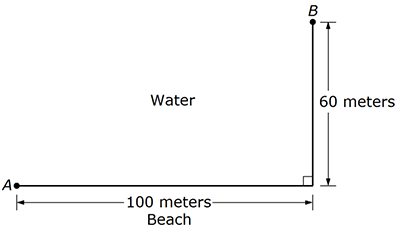
A lifeguard sitting on a beach at point A sees a swimmer in distress at point B. The lifeguard can run at a rate of 3 meters per second and can swim at a rate of 1.5 meters per second. To minimize the amount of time it takes to reach the swimmer, how far along the beach should the lifeguard run before entering the water?
- 40 meters
- 65 meters
- 73 meters
- 100 meters
Suggested Approach
Read the question carefully and critically. Think about what it is asking and the situation it is describing. Eliminate any obviously wrong answers, select the correct answer choice and mark your answer.
In analyzing this problem, redrawing the diagram to highlight the important information may be helpful.
The diagram is repeated without the labels for the beach and water. Point C has been added to the horizontal line. The distance from point A to point C is dimensioned as D. The remaining distance is dimensioned as 100 minus D. A line has been drawn from point B to point C, forming a right triangle with the vertical line as its long side and B C as its hypotenuse.
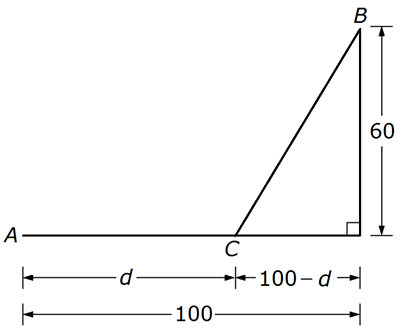
Let d represent the distance in meters that the lifeguard runs along the beach. Then by an application of the Pythagorean theorem, the distance traveled in water is represented by the square root of the quantity 60 squared plus left paren 100 minus D right paren squared . Because distance = rate × time and the lifeguard can run at 3 meters per second and swim at 1.5 meters per second, the time it takes the lifeguard to run along the beach, t sub b, can be represented by d over 3, and the time it takes the lifeguard to swim in the water, t sub w, can be represented by the square root of the quantity 60 squared plus left paren 100 minus D right paren squared all over 1.5. Thus, the total time, t, it takes the lifeguard to travel to the swimmer can be represented by t sub b plus t sub w. To solve the problem, we need to find the value of d that minimizes the function t equals t sub b plus t sub w equals d over 3 plus the square root of the quantity 60 squared plus left paren 100 minus D right paren squared all over 1.5. This can be done using either differential calculus or a graphing approach. We will use a graphing approach. A graphing calculator can be used to produce a graph similar to the one that follows.
There is line graph. The vertical axis is labeled Time in seconds, with values marked from 60 to 80 in increments of 5. The horizontal axis is labeled Distance in meters, with values marked from 0 to 100 in increments of 20. The smooth data curve starts on the Time axis at a value of about 77.5. It slopes down at about a 45 degree angle, then curves to pass horizontally through a point labeled 65.4, 68.0. It then curves upward to a time value of about 72.5 at 100 meters.
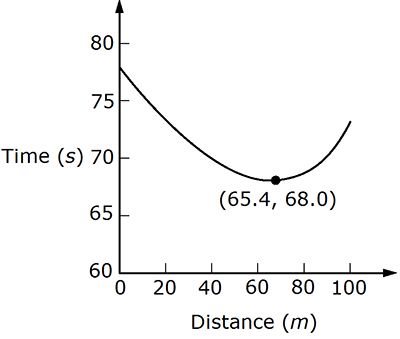
Using the capabilities of the calculator, you see that the minimum value of the function t occurs when d is approximately 65 meters, or option B.
Option A results from dividing 60 by 1.5, which is the time required to swim 60 meters. Option C results from misusing parentheses when entering the equation for t into the graphing utility; i.e., entering t equals d over 3 plus the square root of the quantity 60 squared plus left paren 100 minus D right paren squared all over 1.5 instead of t equals d over 3 plus the square root of the quantity 60 squared plus left paren 100 minus D right paren squared all over 1.5. Option D results from minimizing the function t sub w equals the square root of the quantity 60 squared plus left paren 100 minus D right paren squared all over 1.5 instead of the expression for t, the total time required to reach the swimmer. The correct response is option B.
Clustered Questions
Clustered questions are made up of a stimulus and two or more questions relating to the stimulus. The stimulus material can be a reading passage, graphic, table, or any other information necessary to answer the questions that follow.
You can use several different approaches to respond to clustered questions. Some commonly used strategies are listed below.
| Strategy 1 | Skim the stimulus material to understand its purpose, its arrangement, and/or its content. Then read the questions and refer again to the stimulus material to obtain the specific information you need to answer the questions. |
|---|---|
| Strategy 2 | Read the questions before considering the stimulus material. The theory behind this strategy is that the content of the questions will help you identify the purpose of the stimulus material and locate the information you need to answer the questions. |
| Strategy 3 | Use a combination of both strategies. Apply the "read the stimulus first" strategy with shorter, more familiar stimuli and the "read the questions first" strategy with longer, more complex or less familiar stimuli. You can experiment with the sample questions in the preparation manuals and then use the strategy with which you are most comfortable when you take the actual exam. |
Whether you read the stimulus before or after you read the questions, you should read it carefully and critically. You may want to note its important points to help you answer the questions.
As you consider questions set in educational contexts, try to enter into the identified teacher's frame of mind and use that teacher's point of view to answer the questions that accompany the stimulus. Be sure to consider the questions only in terms of the information provided in the stimulus — not in terms of your own experiences or individuals you may have known.
Example 1
First read the stimulus (a description of a physics experiment along with a data table).
Use the information below to answer the questions that follow.
A group of students is measuring how long it takes a toy car released from rest to roll down a straight inclined track. The data from the experiment are summarized below.
Mass of car 0.10 kg Length of incline 2.0 m Slope of incline 30° Average time 1.2 s 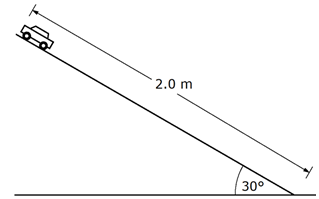
Now you are prepared to address the first of the two questions associated with this stimulus. The first question measures Mathematics/Physical Science/Engineering 6–12 Competency 026: The teacher understands the laws of motion.
1. What is the magnitude of the gravitational force acting on the car in the direction of the toy car's motion down the track?
- 0.10 N
- 0.49 N
- 0.85 N
- 0.98 N
Suggested Approach
The first step is to identify the forces acting on the car. In this case, the forces acting on the car are the force of gravity, the force of friction and the normal force from the inclined plane on the car. The next step is to draw a free body diagram showing these forces resolved into their appropriate components.
The diagram shows a right triangle with the acute angle dimensioned as 30°. Near the middle of the hypotenuse is a set of 5 arrows representing the forces on the toy car as it moves down the incline. All arrows originate at a single point at a slight distance from the incline, as if at the center of mass of the toy car. One arrow, pointing down the slope and parallel to the incline, is labeled mg sin θ. One arrow, pointing up the slope and parallel to the incline, is labeled F sub f. One arrow, pointing at a right angle away from the incline, is labeled N. One arrow, pointing at a right angle toward the incline, is labeled mg cos θ. And one arrow, pointing vertically down, is labeled mg. The angle between the vertical arrow and the arrow pointing at a right angle toward the incline is dimensioned as θ.
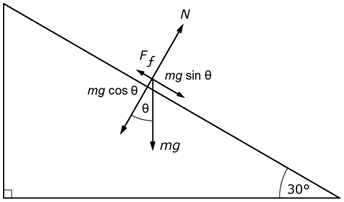
To determine the magnitude of the gravitational force acting on the car in the direction of the car's motion down the track, it is necessary to determine the component of the gravitational force along the incline. For an inclined plane, this component is given by F = mg sin θ, where m is the mass of the car, g is the acceleration due to gravity (9.8 m/s2 squared), and sin θ is the sine of the angle of the incline with the horizontal. Substituting the given values into the expression and using the fact that sin 30° = 0.5 results in the numerical value for the force component acting along the plane, or F = 0.49 N. This is option B.
Option A is the mass of the car and is therefore incorrect. Option C results from incorrectly using mg cos 30° for the component of the gravitational force in the direction of the car's motion. Option D is the weight of the car, which is equal to the magnitude of the gravitational force mg toward the center of the earth. Therefore, the correct response is option B.
Now you are ready to answer the next question. The second question also measures Mathematics/Physical Science/Engineering 6–12 Competency 026: The teacher understands the laws of motion.
2. Assuming the acceleration of the car down the track is constant, what is the net force acting on the car in the direction of the car's motion down the track?
- 0.21 N
- 0.28 N
- 0.56 N
- 0.98 N
Suggested Approach
The second question for this stimulus asks for the net force acting on the car in the direction of the car's motion. According to Newton's second law of motion, the net force on any object in the direction of the object's motion is equal to the object's mass multiplied by its acceleration, or F subscript net equals m a. Because the mass of the car is known, it is necessary to find the acceleration of the car. The question tells us to assume the acceleration is constant. Also, it is given from the original stimulus data that the car starts from rest and travels a distance of 2.0 m in 1.2 s. The expression for the distance traveled by an object undergoing constant acceleration, x equals 1 half a t squared plus v sub 0 t plus x sub 0 , simplifies to x equals 1 half a t squared. In this problem, therefore, solving for a yields a = 2x over t squared = 2 left paren 2.0 right paren over left paren 1.2 right paren squared = 2.8 m/s2 squared. Multiplying this value by the mass of the car results in 0.28 N, which is option B.
Option A results from incorrectly calculating the acceleration as the distance the object travels divided by the time required, or 2.0 over 1.2, and using this value to find the force. Option C results from correctly determining the acceleration and multiplying the result by the mass of the car but then incorrectly trying to find the component of the force parallel to the plane by dividing the result by sine 30 degrees, or 0.5. Option D is the force of gravity on the object. The correct response is option B.
Example 2
First read the stimulus (a learning expectation from the statewide mathematics curriculum).
Use the student expectation below from the Texas Essential Knowledge and Skills (TEKS) to answer the questions that follow.
The student uses characteristics of the quadratic parent function to sketch the related graphs and makes connections between the y equals ax squared plus bx plus c and the y equals a left paren x minus h right paren squared plus k symbolic representations of quadratic functions.
Now you are prepared to address the first of the two questions associated with this stimulus. The first question measures Mathematics/Physical Science/Engineering 6–12, Competency 020: The teacher understands how children learn mathematics, and plans, organizes and implements instruction using knowledge of students, subject matter and statewide curriculum (Texas Essential Knowledge and Skills [TEKS]).
1. Which of the following algebraic techniques will students need to know to symbolically convert a quadratic function of the form y equals ax squared plus bx plus c into the form y equals a left paren x minus h right paren squared plus k?
- Solving systems of equations
- Completing the square
- Solving quadratic equations
- Simplifying polynomial expressions
Suggested Approach
You are asked to identify the algebraic technique that students should use to convert the expression y equals ax squared plus bx plus c into the expression y equals a left paren x minus h right paren squared plus k. The following steps show how this conversion can be achieved.
First rewrite the expression y equals ax squared plus bx plus c as y equals a left paren x squared plus start fraction b over a end fraction x right paren plus c by factoring a from the quantity ax squared plus bx. Next, take one-half the coefficient of the linear term, square it and add this quantity inside the parentheses while adding the product of the quantity's additive inverse and a outside of the parentheses. Note that this is equivalent to adding fraction b squared over 4 a and negative fraction b squared over 4 a to the same side of the equation as follows:
y equals a left paren x squared plus start fraction b over a end fraction x plus start fraction b squared over 4 a squared end fraction right paren plus c minus start fraction b squared over 4 a end fraction
Notice that the quantity inside the parentheses is a perfect square and can be factored.
y equals a left paren x plus start fraction b over 2 a end fraction right paren squared plus c minus start fraction b squared over 4 a end fraction
This expression is equivalent to y equals a left paren x minus h right paren squared plus k, with h equals negative fraction b over 2 a and k equals fraction 4 a c minus b squared over 4 a, which are the x- and y-coordinates of the vertex of the graph of y equals ax squared plus bx plus c. This algebraic method of converting the first expression into the second is known as completing the square. Therefore, option B is correct.
Option A, solving systems of equations, is not helpful in this situation because the student is being asked to rewrite an equation, not solve it. Option C is incorrect because the student is being asked to rewrite a quadratic equation, not solve it. Finally, although one can simplify the expression y equals a left paren x minus h right paren squared plus k and compare it to y equals ax squared plus bx plus c, this approach is ineffective when applied in the opposite direction, which makes option D incorrect.
Now you are ready to answer the next question. The second question measures Competency 021: The teacher understands assessment and uses a variety of formal and informal assessment techniques to monitor and guide mathematics instruction and to evaluate student progress.
2. Which of the following exercises best assesses student understanding of the expectation from the statewide curriculum (TEKS)?
- Use a graphing calculator to graph the function y equals x squared minus 4x plus 3, and use the graph to find the zeros of the function.
- Write a real-world word problem that is modeled by the function y equals x squared minus 4x plus 3, and relate the solution of the function to the graph of y equals x squared minus 4x plus 3.
- Describe how the graph of y equals left paren x minus 3 right paren left paren x minus 1 right paren is related to the graph of y equals x squared minus 4x plus 3.
- Describe how the graph of y equals x squared is related to the graph of y equals x squared minus 4x plus 3.
Suggested Approach
You are asked to select an activity that would best assess student understanding of converting a function of the form y equals ax squared plus bx plus c into the form y equals a left paren x minus h right paren squared plus k and then analyzing the graph of this function in relation to the quadratic parent function y equals x squared. Carefully read each of the responses to determine how well they assess student understanding of this topic.
Option A asks the student to enter a quadratic function into a graphing calculator and then use the capabilities of the graphing calculator to estimate the zeros of the function. This is a method of using technology to solve a quadratic equation, and hence is incorrect.
Option B asks the student to create a problem that can be modeled by a specific quadratic equation and to relate the graph of the equation to the problem. This assessment would be useful for evaluating student understanding of applications of quadratic functions but not for assessing understanding of the two different symbolic representations of the quadratic function. Option B is therefore incorrect.
Option C assesses understanding of the fact that a factored quadratic function has the same graph as the expanded, or unfactored, quadratic function. Option C would not assess the given learning expectation and is therefore incorrect.
Option D assesses student understanding of how the graph of y equals x squared is related to that of a more complicated quadratic function involving a linear term and a constant term. Expressing the function y equals x squared minus 4x plus 3 in the form y equals left paren x minus 2 right paren squared minus 1 allows a student to determine by inspection that the vertex is at (2, negative 1). This implies that the graph of y equals x squared minus 4x plus 3 can be obtained by translating the graph of y equals x squared two units in the positive x-direction and one unit in the negative y-direction.
This analysis of the four choices should lead you to select option D as the correct response.
Return to Navigation