
Question Types
You may see the following types of selected-response questions on the exam:
- Single Questions
- Clustered Questions
Below you will find descriptions of these commonly used question formats, along with suggested approaches for responding to each type.
Single Questions
The single-question format presents a direct question or an incomplete statement. It can also include a reading passage, movie clip, graphic, table, or a combination of these.
Example
The following question is an example of the single-question format. It tests knowledge of English Language Arts and Reading 7–12 Competency 002—(Vocabulary Development): Understand concepts, principles, and best practices related to vocabulary development, and demonstrate knowledge of developmentally appropriate, research- and evidence-based assessment and instructional practices to promote all students' development of grade-level vocabulary knowledge and skills.
Seventh-grade students skim an article about a Texas Revolution battle to get the gist and to identify words that begin with the roots gen, log, and sent. Students identify general, logistics, and sensible. Which of the following strategies would be most effective in promoting students' ability to learn and use these words?
- asking students to go back to the text and substitute synonyms for the unfamiliar words while reading
- giving students definitions and asking them to match the unfamiliar words to the correct definitions
- providing students with frequent opportunities to use the words in discussions and written responses
- giving students another article to read that also includes the unfamiliar words
Suggested Approach
Read the question carefully and critically. Think about what it is asking and/or the situation it is describing. Eliminate any answers that seem obviously wrong to you, select the correct answer choice, and mark your answer.
As you read the question, think about strategies that would help students learn words that begin with roots, such as gen, log, and sent. Then think about how a teacher could effectively help students incorporate words containing these roots, such as general, logistics, and sensible, into their working vocabulary.
Option A suggests that students will be asked to reread the text and substitute alternative words for the target words.
Option B suggests that students will be provided with definitions to match to the unfamiliar target words.
Option C suggests that students will be given multiple, frequent opportunities to use the target words appropriately in discussions and written work.
Option D suggests that students will be asked to read a different article that includes the unfamiliar target words.
Of the options offered, only option C shows the teacher providing students with strategies to learn roots and their resulting words through authentic exposure and language use. Therefore, the correct response is option C.
Clustered Questions
Clustered questions are made up of a stimulus and two or more questions relating to the stimulus. The stimulus material can be a reading passage, graphic, table, or any other information necessary to answer the questions that follow.
You can use several different approaches to respond to clustered questions. Some commonly used strategies are listed below.
| Strategy 1 | Skim the stimulus material to understand its purpose, its arrangement, and/or its content. Then read the questions and refer again to the stimulus material to obtain the specific information you need to answer the questions. |
|---|---|
| Strategy 2 | Read the questions before considering the stimulus material. The theory behind this strategy is that the content of the questions will help you identify the purpose of the stimulus material and locate the information you need to answer the questions. |
| Strategy 3 | Use a combination of both strategies. Apply the "read the stimulus first" strategy with shorter, more familiar stimuli and the "read the questions first" strategy with longer, more complex or less familiar stimuli. You can experiment with the sample questions in the preparation manuals and then use the strategy with which you are most comfortable when you take the actual exam. |
Whether you read the stimulus before or after you read the questions, you should read it carefully and critically. You may want to note its important points to help you answer the questions.
As you consider questions set in educational contexts, try to enter into the identified teacher's frame of mind and use that teacher's point of view to answer the questions that accompany the stimulus. Be sure to consider the questions only in terms of the information provided in the stimulus — not in terms of your own experiences or individuals you may have known.
Example
First read the stimulus (classroom scenario).
Use the information below to answer the two questions that follow.
An English IV teacher presents Annie Dillard's essay "Lenses" as a mentor text for students to use as a model when writing informational essays with a strong voice. The teacher asks students to annotate the text by noting words and phrases that the author uses to connect ideas. One student's annotation appears below.
The essay excerpt reads: You get used to looking through lenses; it is an acquired skill. When you first look through binoculars, sup 1 for instance, you can’t see a thing. Sup 2 You look at the inside of the barrel; you blink and watch your eyelashes; you play with the focus knob till one eye is purblind. The microscope is sup 3 even worse. You are supposed to keep both eyes open as you look through its single eyepiece. I spent my childhood in Pittsburgh trying to master this trick: seeing through one eye, with both eyes open. The microscope sup 4 also teaches you to move your hands wrong, to shove the glass slide to the right if you are following a creature who is swimming off to the left—as if you were operating a tiller, or backing a trailer, or performing any other of those paradoxical maneuvers which require either sure instincts or a grasp of elementary physics, neither of which I possess. Annotations appear in boxed text in the margins. Annotation 1 is in the left margin next to the first paragraph. It reads quote for instance unquote indicates first example of looking through lenses. Annotation 2 is in the right margin next to the first paragraph. It reads details related to first example. Annotation 3 appears in the right margin next to the beginning of the second paragraph. it reads quote even worse unquote emphasizes comparison between first and second examples. Annotation 4 appears in the left margin next to the middle of the second paragraph. It reads quote also unquote introduces additional information about second example.
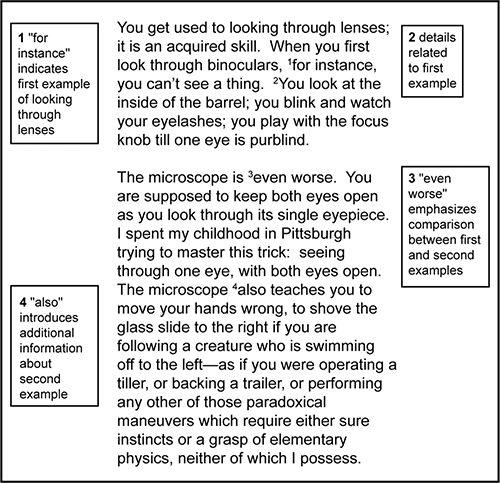
Now you are prepared to respond to the first of the two questions associated with this stimulus. The first question tests English Language Arts and Reading 7–12 Competency 006—(Composition): Understand the characteristics of various genres of written text and apply knowledge of research-based strategies and best practices for promoting students' ability to develop well-organized, engaging, written texts that achieve specific purposes for specific audiences.
1. As students read the text a second time, which of the following activities would best promote students' ability to use the text as a model for developing engaging ideas with relevant, specific facts and details in their own writing?
- identifying appeals to logic and emotion
- examining the use of precise imagery and analogies
- determining the author's purpose and audience
- analyzing how the author creates a humorous tone
Suggested Approach
As you read the question, think about the purpose of using this text as a model for students' writing. The activity should promote students' ability to develop engaging ideas with relevant, specific facts and details in their own writing. Consider how the mentor text can support students' understanding of how authors develop ideas with specific facts and details.
Option A suggests that students use appeals to logic and emotion in their own writing. Identifying these appeals in a mentor text would be appropriate for an argumentative essay, but students are reading and writing informational essays.
Option B suggests that students use precise imagery and analogies in their own writing. Examining the use of precise imagery and analogies in the mentor text would promote their ability to develop and connect specific details in their own essays.
Option C suggests that students use the author's purpose and audience in their own writing. Determining the purpose and audience of the mentor text would require students to examine the central idea and tone of the text, but it would not promote students' ability to develop relevant, specific details in their own writing.
Option D suggests that students use the author's humorous tone in their own writing. Analyzing how the author creates a humorous tone in a mentor text would help students consider how to use specific word choices to achieve a particular effect, but it would not promote the development of engaging ideas with specific, relevant details.
Of the options offered, only option B promotes students' understanding of how authors develop ideas with relevant, specific facts and details. Therefore, the correct response is option B.
Now you are ready to answer the second question. The second question tests English Language Arts and Reading 7–12 Competency 006—(Composition): Understand the characteristics of various genres of written text and apply knowledge of research-based strategies and best practices for promoting students' ability to develop well-organized, engaging, written texts that achieve specific purposes for specific audiences.
2. After reading and analyzing the mentor text, students prepare to revise first drafts of an informational essay they have written. Which of the following approaches would be most effective for students to use to revise their essays for a purposeful text structure?
- circling transition words and phrases in their essays that also appear in the mentor text
- highlighting the thesis statement, introduction, and conclusion in the mentor text and in their own essays
- identifying organization strategies used in the mentor text and how those strategies can be useful in their own essays
- writing a second draft of their essays using a text structure like that of the mentor
Suggested Approach
As you read the question, think about how the mentor text can promote students' understanding of purposeful text structure and how they can use that understanding to revise their own essays.
Option A suggests that identifying transition words and phrases that appear in the mentor text and their own essays would help students revise their essays for a purposeful text structure. While this activity might promote students' understanding of how the mentor text's author organizes ideas, it would not effectively support students' ability to revise their essays for a purposeful text structure.
Option B suggests that identifying the thesis statement, introduction, and conclusion in the text and their own essay would help students revise their essays for a purposeful text structure. This activity would support students' ability to identify organizational features in each text, but highlighting these features would not support their ability to revise their own text structure for a specific purpose.
Option C suggests that identifying organization strategies used in the mentor text and how those strategies can be useful in their own essays would help students revise their essays for a purposeful text structure. Identifying how specific organization strategies from the mentor text can be used in their own essay would promote students' ability to revise their own essays for a purposeful text structure.
Option D suggests that writing a second draft with a text structure like that of the mentor text would help students revise their essays for a purposeful text structure. While this activity would require them to revise the text structure of their essay, simply copying the structure of the mentor text would not support students' ability to use a text structure appropriate to their own purpose.
Of the options offered, only option C supports students' understanding of how to use a purposeful text structure. Therefore, the correct response is option C.
Acknowledgments
From Teaching a Stone to Talk by Annie Dillard. Copyright © 1982 by Annie Dillard. Used by permission of HarperCollins Publishers.